What is the control layer?

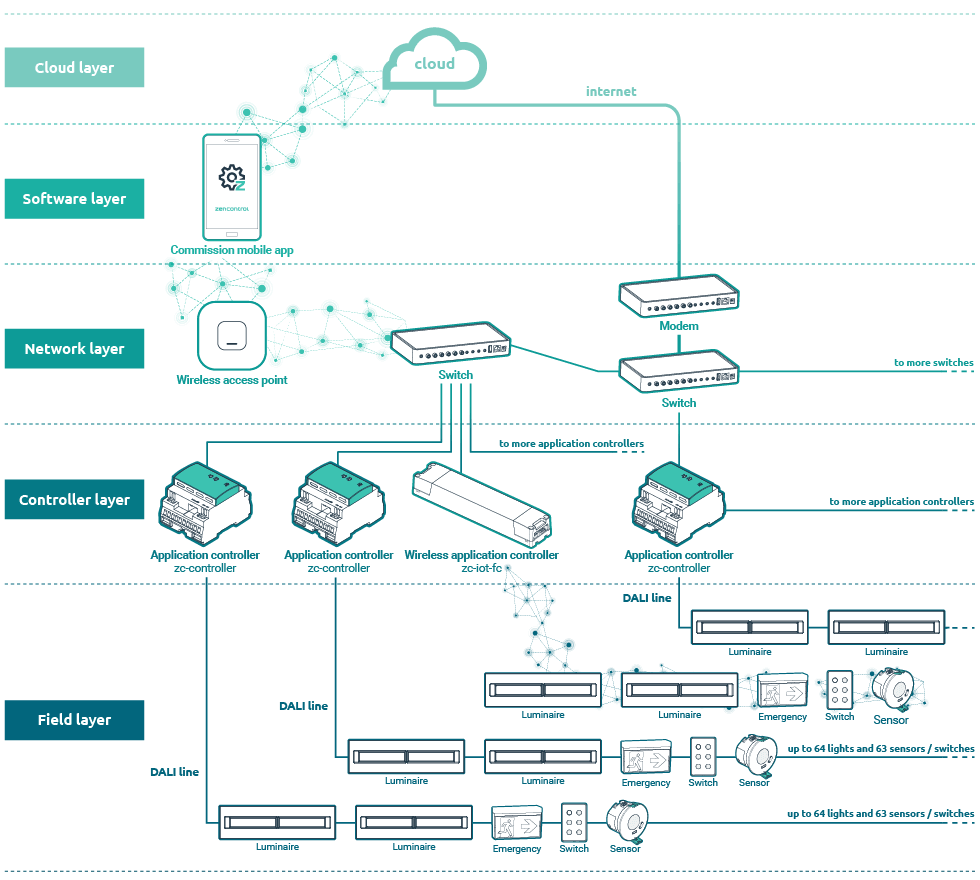
Within the control layer, zencontrol application controllers do the heavy lifting: they run schedules, switching logic, sensor interactions, and building-wide behaviours (scenes, sequences, and events). Controllers share state and control information with other controllers so the installation behaves as a consistent whole.

This is particularly powerful in real spaces where “one area” spans multiple controllers: switches, sensors and indicators can remain aligned because the control layer distributes state across the network rather than relying on a single master.

In practice: one controller can initiate an action, and other controllers react intelligently with synchronised behaviour (including LED indicator state on switches).

Designed for complex buildings
The control layer is built for buildings that change over time: tenant churn, refurbishment stages, mixed technologies (wired and wireless), and new integrations. It gives you a clean backbone to keep expanding without redesigning the system architecture.
Alt Text

Cabling: ethernet backbone with clean connections to the field

Because the control layer is standard IP, it blends naturally with modern infrastructure: copper ethernet on a floor, fibre between buildings, routed links across a campus, and secure WAN connectivity for multi-site estates.

Alt Text

Upward: controller → systems & cloud
The same IP backbone connects to BMS/AV/IoT platforms and zencontrol cloud for commissioning, upgrades, analytics and permissions management.


Sideways: controller ↔ controller
Controllers communicate over standard ethernet. Many zencontrol controllers include 10/100 TCP/IP ports designed to be switch-compatible with standard IT equipment.


Downward: controller → field layer
Each application controller connects to one or more field buses where the end devices live (lighting, relays and sensors). New buses are added by adding controllers.

Alt Text

Scalability: add controllers, use standard IT, keep it manageable

The control layer can contain many application controllers, each with their own field buses. Because controllers use standard ethernet and connect through normal IT switching and routing, scaling the system is straightforward: add controllers, connect them to the network, and commission new areas.

Operationally, large projects are typically broken into smaller, manageable segments (by tenancy, floor, or building) and then linked together. At portfolio scale, zencontrol supports “organisations” in the cloud to help structure and manage multiple sites coherently.

This is what makes growth clean: the building’s physical expansion aligns with the network’s natural shape, and cloud governance keeps multi-site access and ownership under control.

Governance at scale
The cloud manages ownership and permissions and supports fine-grained access controls (including “limited” access scopes), making it practical to operate large sites with many stakeholders.

Control layer IP services: integration-ready “inputs” and “outputs”

Outputs: to BMS via BACnet
BACnet integration supports control of groups and scenes and can expose states such as occupancy, enabling coordinated building services. zencontrol also maps logical names (rooms/locations/floors) to BACnet object labels for easier cross-referencing.

Outputs: to IoT via MQTT
MQTT integration supports third-party interfacing and subscribing to system information for dashboards, analytics and automation workflows.

Outputs: to AV/controls via TPI
The Third Party Interface (TPI) is an add-on that allows third-party devices to send commands to application/room controllers (including via UDP and RS485), supporting external overrides and integration workflows.

Alt Text

Inputs: commands from other systems

  • BMS commands (e.g. BACnet writes) to control groups/scenes and manage operational states.
  • MQTT Stream MQTT events and control over IP
  • AV commands via controller UDP or serial interfaces where applicable.
  • DMX interaction where supported, including control alongside DALI and ethernet-based sACN workflows.
  • IoT triggers and data flows via MQTT for automations and reporting.
Alt Text

Other control layer advantages that matter day-to-day

Alt Text

Fault-tolerant design intent
zencontrol positions distributed intelligence as a foundation for resilient operation across wired and wireless networks, including standalone behaviour.

Alt Text

Cloud operations and lifecycle
The cloud supports commissioning, emergency test supervision, analytics/energy monitoring, and upgrades of control systems and devices—critical for long-lived assets.

Alt Text

Controlled access for stakeholders
Site owners can grant scoped access (e.g. only specific control systems or areas) using explicit permissions, supporting tenants, contractors and facilities teams.

Build the backbone once — expand forever

The control layer turns lighting into building infrastructure: standard ethernet, multi-master intelligence, and clean integration paths for BMS, AV and IoT — from a single floor to campus-scale and multi-site portfolios.

Software & network resources

Application controller Pro 3

Multi-line controller with standard ethernet switching, higher performance, and expanded sequence capability.

DALI-2 application controller

DIN-rail controller with DALI-2 certification and 10/100 TCP/IP built for standard IT networks.

Controller Hub

Field-mount room control options combining DALI control with ethernet for networked deployment.

Wireless application controller

10/100 ethernet gateway that brings DALI+ over Thread networks into the broader control layer.

Integrations overview

High-level list of supported integration methods including BACnet, MQTT, TPI and Advanced TPI.

TPI documentation

How third-party systems send commands to controllers (UDP/serial), including licensing notes.